

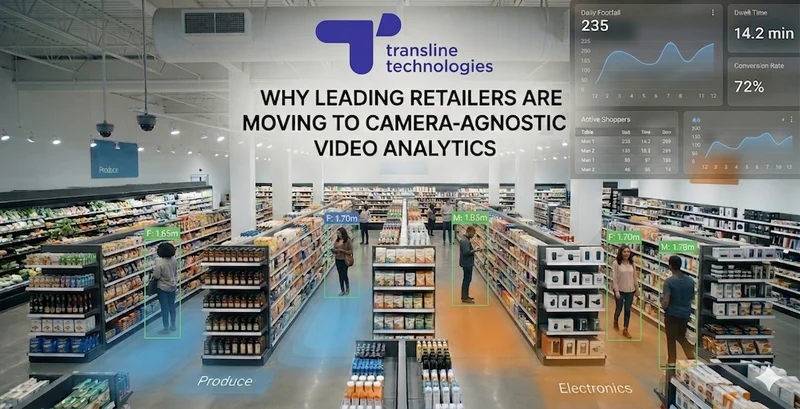
The security camera market has changed dramatically over the past decade. Retailers across the United States have invested heavily in IP camera infrastructure, building out networks of tens, hundreds, or even thousands of cameras across store locations. The question most operations and loss prevention leaders are now asking is not whether to add video analytics. It is how to add it without starting over.
For years, the dominant approach required retailers to adopt an end-to-end platform: proprietary cameras, proprietary software, proprietary cloud storage, and a recurring licence that locked the entire system to a single vendor. If you wanted the analytics, you bought the cameras. If you wanted to keep the analytics, you kept paying.
A growing number of US retailers are rejecting this model entirely. They are choosing camera-agnostic video analytics platforms that layer AI intelligence directly onto the cameras they already own, turning existing infrastructure into a real-time retail intelligence system without replacing a single device.
StorePulse AI by Transline Technologies is built on exactly this principle. No hardware replacement, no vendor dependency, no ripping out infrastructure that is working perfectly well. Just powerful AI analytics running on your existing camera network from day one.
The Problem with Locked-In Video Systems
When a video analytics platform is tied to its own proprietary hardware, the retailer loses control the moment they sign the contract. Expanding to a new store location means buying new cameras from the same vendor at the same price point. Upgrading analytics features means accepting whatever the vendor decides to release on their timeline. And switching to a different platform in the future means writing off every camera in the network.
For a retail chain with 50 locations and an average of 20 cameras per store, that is 1,000 cameras that become a sunk cost the moment a better analytics solution comes along. This is not a technology problem. It is a procurement strategy problem.
The retailers making the smartest long-term infrastructure decisions are the ones separating the hardware layer from the software layer. They buy cameras on their own terms, from whatever manufacturer offers the best value at the time, and they choose analytics software independently based on capability. This is what camera-agnostic architecture enables.
What Camera-Agnostic Video Analytics Actually Means
Camera-agnostic video analytics means the software platform does not care what cameras you have. It integrates with IP cameras from any credible manufacturer using standard protocols, processes the video feed through an AI engine, and delivers analytics outputs regardless of the hardware brand behind the lens.
In practice this means a retailer running a mix of camera brands across different store generations, some installed five years ago and some installed last year, can run a single unified analytics platform across all of them. There is no need for a hardware refresh. There is no compatibility negotiation. The software connects, processes, and delivers.
StorePulse AI integrates with existing credible IP camera infrastructure across retail environments of all sizes, from single-location independents to multi-state chains. The onboarding process starts with what you have, not with what a vendor wants to sell you.
What Retailers Actually Get From the Analytics
The shift to camera-agnostic AI video analytics is not just about architecture flexibility. It is about the quality and depth of insight the platform delivers once it is running.
StorePulse AI delivers real-time footfall counting with accuracy above
98 percent, tracking every entry and exit across every store location simultaneously. Zone-level heat maps show where shoppers spend time, which areas drive dwell and which are consistently walked past. Conversion rate tracking compares visitor count to transaction count in real time, giving operations teams an immediate read on whether foot traffic is translating to sales.
Demographic insights including age range and gender distribution give merchandising and marketing teams the data to understand who is actually shopping in each store and at what times. Queue detection alerts flag when checkout lines exceed defined thresholds, triggering staff reallocation before customers abandon their baskets.
All of this runs on the cameras already installed in the store. The AI does the work. The retailer gets the intelligence.
The Loss Prevention Layer
Footfall and behaviour analytics are the headline capability but the loss prevention applications are equally significant for US retail operations teams.
StorePulse AI monitors defined zones in real time, flagging extended loitering in high-value product areas, detecting unusual movement patterns near exits, and generating alerts when camera feeds are obscured or interrupted. Loss prevention teams receive actionable alerts rather than spending hours reviewing footage after an event has already occurred.
For multi-location retail chains, centralised monitoring means the loss prevention function can oversee every store from a single dashboard without physical presence at each location. Incidents are flagged, timestamped, and indexed automatically for immediate investigation.
Why US Retailers Are Making the Switch Now
Several converging factors are driving US retailers toward camera-agnostic video analytics platforms in 2026.
First, the existing camera infrastructure in most US retail chains is already capable of supporting AI analytics. Modern IP cameras have the resolution and network connectivity that AI platforms need. The hardware investment has already been made. Adding analytics is a software decision, not a capital expenditure.
Second, the pressure on retail operations and loss prevention teams to do more with less is intensifying. Shrink rates in US retail reached an estimated 1.6 percent of sales in 2024 according to the National Retail Federation, representing tens of billions of dollars in annual losses across the industry. Retailers who can deploy AI-powered loss prevention across their entire camera network without a hardware refresh have a clear operational and financial advantage.
Third, the flexibility of camera-agnostic platforms means retailers can scale analytics to new store locations immediately, using whatever cameras are already installed, without waiting for a hardware procurement cycle.
StorePulse AI: Proven at Scale, Built for Global Retail
StorePulse AI is a proprietary AI video analytics platform developed by Transline Technologies and proven across retail deployments at scale. The platform has been built from the ground up for retail operational intelligence, covering footfall analytics, shopper behaviour mapping, zone heat mapping, conversion tracking, queue detection, and loss prevention alerting.
Having been proven across demanding retail environments in one of the world's most complex and high-volume retail markets, StorePulse AI is now expanding to serve retail operations teams in the United States and globally. The platform brings enterprise-grade AI analytics capability, camera-agnostic flexibility, and on-premise deployment options to US retailers who want the intelligence without the hardware dependency.
For retail operations heads and loss prevention teams evaluating video analytics platforms in 2026, StorePulse AI represents a fundamentally different approach: start with what you have, get the intelligence you need, and retain full control of your infrastructure going forward.
Frequently Asked Questions
Does StorePulse AI work with the cameras we already have installed in our stores?
Yes. StorePulse AI is camera-agnostic and integrates with existing IP camera infrastructure from any credible manufacturer. There is no requirement to replace or upgrade your current cameras to get started.
How long does it take to deploy StorePulse AI across a retail location?
Deployment timelines vary based on the number of cameras and the complexity of the store network. StorePulse AI is designed for fast onboarding onto existing infrastructure, with most single-location deployments going live significantly faster than a full hardware replacement project would require.
Is StorePulse AI suitable for a multi-location retail chain across different US states?
Yes. StorePulse AI is built for multi-location retail operations, providing a single centralised dashboard that gives operations and loss prevention teams visibility across every store location simultaneously, regardless of geographic distribution.
Book a Demo
If your retail operation is evaluating video analytics platforms and you want to see what StorePulse AI can deliver on your existing camera infrastructure, the starting point is a demonstration on your actual setup.
Transline Technologies works with retail operations teams and loss prevention leaders to configure StorePulse AI around the specific requirements of each retail environment. No generic demos. No hardware sales pitch. Just a clear view of what the platform delivers for your stores.