
Smart City Surveillance Systems: How They Work and What to Know
Smart City Surveillance System India Guide 2026 | Transline Technologies
India's Smart Cities Mission has created a clear mandate for technology-driven urban management. Launched in 2015 and now in its advanced phases, the programme has channelled significant investment into integrated infrastructure across 100 designated cities. Among the most consequential of these investments are the Integrated Command and Control Centres that sit at the heart of modern urban security and management.
A smart city surveillance system is the backbone of any functioning ICCC. Yet the term is frequently used loosely, covering everything from a basic IP camera network to a fully integrated AI-driven urban operations platform. This guide clarifies what a genuine smart city surveillance system deployment looks like, how it works, and what urban bodies and decision makers should understand before evaluating or procuring this infrastructure.
If you are involved in planning, procurement, or oversight of smart city surveillance and monitoring infrastructure, this is the reference you need.
What a Smart City Surveillance System Actually Is
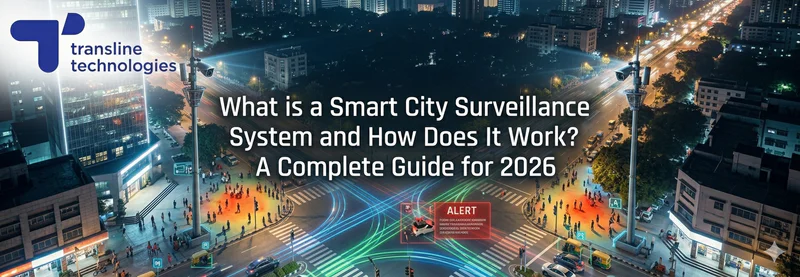
A smart city surveillance system is not simply a large CCTV network. It is an integrated platform that combines high-definition cameras, AI-powered video analytics, IoT-based sensors, and a centralised command infrastructure into a single operational system.
The defining characteristic is real-time intelligence. The system does not just record. It detects, classifies, and routes actionable information to the right person at the right time. Traffic violations, crowd anomalies, environmental alerts, infrastructure faults, and security incidents are all surfaced within seconds of occurring, without requiring a human operator to watch every camera simultaneously.
The Core Components
Camera Infrastructure: Fixed HD IP cameras cover standard monitoring zones. PTZ cameras provide active tracking capability for incidents in progress. Thermal cameras extend coverage to low-light and perimeter applications. Camera placement is determined by coverage modelling, not just density. More cameras in the wrong locations produce worse outcomes than fewer cameras planned correctly.
AI Video Analytics Engine: This is the intelligence layer that processes live feeds from every camera simultaneously. Algorithms handle crowd density analysis, facial matching, vehicle tracking, abandoned object detection, and behavioural anomaly identification without requiring a human operator to watch each feed.
IoT-Based City Monitoring Integration: Environmental sensors, gunshot detection devices, emergency call points, traffic management systems, and utility monitoring tools can all feed into the same platform. The result is a unified operational picture rather than siloed systems that each require separate management and staffing.
Integrated Command and Control Centre: The ICCC is where trained operators receive AI-generated alerts, review relevant footage, and coordinate response across city departments. Alert routing logic ensures that a traffic incident goes to traffic police, a health emergency goes to the nearest response unit, and a fire alert reaches the fire department automatically.
Data Infrastructure: Redundant, encrypted storage and secure transmission protocols ensure data integrity. Retention policies, access controls, and audit logs are configured at the point of deployment and updated as regulatory requirements evolve.
How the Data Flows
Cameras and sensors continuously capture data. The AI analytics engine processes this data in real time against defined event criteria. When a criterion is met, an alert is generated and routed to the appropriate operator or department. The operator receives a visual confirmation on their dashboard within seconds, with camera reference and location data attached.
The system also builds a continuous historical record that supports post-incident investigation, trend analysis, and infrastructure planning. City administrators can query patterns over time: which intersections see the most traffic violations, which zones have the highest incident frequency, and where emergency response times are longest. This data informs both operational decisions and long-term urban planning.
The State of Smart City Surveillance in 2026
Under the Smart Cities Mission, over 100 cities have developed or are deploying Integrated Command and Control Centres. Cities including Surat, Pune, Bhopal, and Ahmedabad have been recognised by the Ministry of Housing and Urban Affairs for the operational effectiveness of their ICCC deployments. The Surat ICCC, for example, integrates surveillance, traffic management, solid waste monitoring, and emergency dispatch into a single unified platform.
Demand for IoT-based city monitoring platforms continues to grow as urban populations expand and the next phase of smart city infrastructure development gets underway. Municipalities that invest in scalable, AI-ready platforms now will be better positioned to extend their networks cost-effectively as city populations and coverage requirements grow.
Procurement Considerations for Urban Bodies
Smart city surveillance procurement is typically governed by Special Purpose Vehicle (SPV) tender processes and must comply with MeitY guidelines for government IT procurement and data localisation requirements. Key evaluation criteria should include AI analytics capability, integration with existing city systems, vendor support infrastructure, and a credible deployment track record at comparable scale.
Total cost of ownership over a five to ten year lifecycle is a more meaningful evaluation metric than upfront hardware cost. Ongoing software licensing, maintenance contracts, storage expansion, and operator training are all material costs that should be factored into any procurement evaluation.
Transline Technologies works with procurement teams and system integrators on specification development and vendor evaluation. Our objective is to help urban bodies make the right infrastructure decision, not simply to win contracts.
One consideration that is frequently underweighted in smart city procurement is the vendor's after-sales service capability. An internationally sourced system that lacks a local support team creates ongoing operational dependencies that are difficult and expensive to manage. Transline Technologies operates a dedicated support infrastructure with field teams available for on-site response.
Frequently Asked Questions
What is the difference between a smart city surveillance system and a regular CCTV network?
A regular CCTV network records footage for later review. A smart city surveillance system processes live video using AI to detect events in real time, integrate with other city systems, and route alerts automatically to the relevant authority. The operational impact of the two approaches is fundamentally different.
How long does it take to deploy an ICCC for a mid-sized city?
Deployment timelines vary significantly based on the number of cameras, existing infrastructure, and integration complexity. A mid-sized city deployment typically takes between 12 and 24 months from project award to full operational capability, including camera installation, analytics configuration, and operator training.
Can existing CCTV cameras be integrated into a smart city platform?
In many cases, yes, provided the cameras meet minimum resolution and network connectivity requirements. Transline Technologies conducts an infrastructure audit as part of every smart city project to determine what can be reused and what needs to be upgraded.
Transline Technologies and Smart City Projects
Transline Technologies has contributed to smart city surveillance projects at multiple stages: city-wide camera network planning, AI analytics platform integration, ICCC design and setup, and ongoing managed services.
We work with municipal corporations, smart city SPVs, state police departments, and government system integrators. If your organisation is evaluating smart city surveillance infrastructure, our urban solutions team is available for a detailed discussion.
Contact Us